Navigating the aftermath of a collision involving a commercial vehicle is vastly different from a typical passenger car accident. When a delivery van, a freight truck, or a corporate fleet vehicle is involved, the physical damage is often catastrophic, but the legal landscape is even more complex. Determining who is at fault involves peeling back layers of corporate structure, federal regulations, and employment contracts.
Unlike a standard fender-bender where two drivers exchange insurance information, a commercial crash triggers an immediate response from corporate legal teams and specialized adjusters. Their goal is to limit the company’s financial exposure as quickly as possible. To protect your future and ensure you receive the compensation necessary for medical recovery and lost wages, you must understand how liability is distributed among the various parties involved in the commercial transportation industry.
The Doctrine of Vicarious Liability and Employer Responsibility
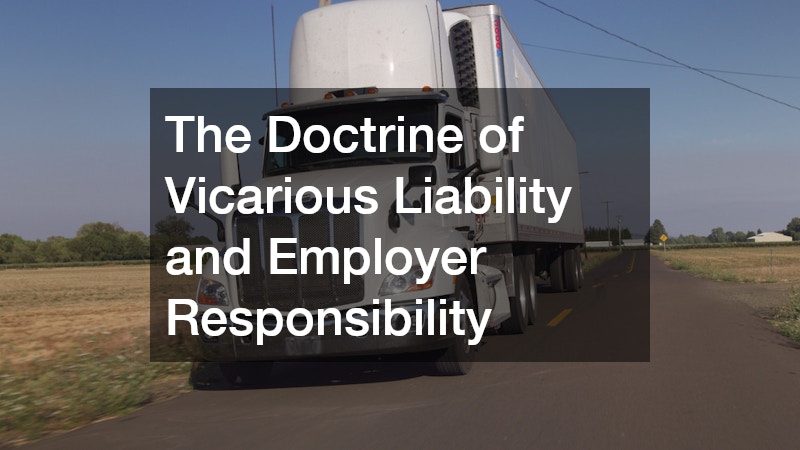
In the legal world, a central concept used to determine fault in commercial accidents is respondeat superior, or vicarious liability. This principle holds that an employer is responsible for the negligent actions of their employees, provided those actions occurred within the scope of their employment. If a driver was making a delivery, traveling between job sites, or operating a company vehicle for business purposes at the time of the crash, the parent company usually shares the blame.
Establishing this connection is a primary task for an auto accident lawyer during the initial investigation. It is not always as straightforward as it seems; companies often try to distance themselves from a driver by claiming they were on a “frolic or detour,” meaning they were engaged in personal business at the moment of impact. Furthermore, a dedicated law firm will look beyond just the driver’s immediate actions to see if the company’s internal policies—such as demanding unrealistic delivery schedules—forced the driver to speed or skip mandatory rest breaks.
The Scope of Employment Test
To prove that an employer is liable, the legal process must verify:
- The employee was performing work assigned by the employer.
- The employee was under the control of the employer at the time.
- The conduct was motivated, at least in part, by a desire to serve the employer’s interests.
Differentiating Between Employees and Independent Contractors
One of the most common hurdles in commercial liability cases is the classification of the driver. Many transport companies utilize independent contractors or “owner-operators” to shield themselves from lawsuits. If a driver is legally classified as an independent contractor, the company may argue that vicarious liability does not apply, potentially leaving the victim to pursue a claim only against the driver’s individual insurance policy, which is often insufficient for serious injuries.
A local injury attorney understands that the label a company puts on a driver doesn’t always hold up in court. Courts look at the “right of control”—does the company dictate the driver’s route, provide the equipment, or set the working hours? If the company exerts significant control over the driver’s daily operations, a personal injury law firm can argue that an employer-employee relationship existed regardless of the contract’s wording. This distinction is vital because it opens the door to the company’s much larger commercial insurance limits.
Federal Safety Regulations and Compliance Violations
Commercial vehicles that travel across state lines are governed by the Federal Motor Carrier Safety Administration (FMCSA). These regulations are incredibly strict and cover everything from how many hours a driver can be behind the wheel to the specific weight of the cargo being hauled. When these rules are broken, it provides powerful evidence of negligence that can be used to hold multiple parties accountable.
Common regulatory violations include:
- Hours of Service (HOS) Infractions: Drivers exceeding their allowed driving time, leading to dangerous levels of fatigue.
- Improper Maintenance: Failing to inspect brakes, tires, or lights, which can lead to mechanical failure at high speeds.
- Overloaded Cargo: Carrying weight beyond the vehicle’s capacity, making it harder to stop or more prone to tipping.
When these violations occur, personal injury lawyers often work with accident reconstruction experts to prove that the breach of federal law was the direct cause of the injury. If you have been struck by a semi-truck, a truck accident attorney will immediately file a “spoliation letter” to ensure the trucking company does not destroy digital logs or maintenance records that could prove these violations occurred.
Liability for Third-Party Maintenance and Cargo Loading
Sometimes, the fault lies with a company that was never even at the scene of the accident. Many commercial fleets outsource their vehicle maintenance to third-party mechanics. If a catastrophic brake failure occurs because a repair shop used substandard parts or performed a negligent inspection, that shop may be held liable for the resulting injuries.
The loading of the vehicle is also a critical factor. If cargo is not secured properly, it can shift during transit, causing the driver to lose control. An accident injury attorney will investigate the entire supply chain to identify every entity that touched the vehicle before the crash. By identifying a negligent cargo loader or a third-party maintenance provider, a car accident lawyer can ensure that all avenues for financial recovery are explored.
Negligent Entrustment and Hiring Practices
Beyond the actual crash, liability can be found in the boardroom. Companies have a duty to ensure they are putting safe drivers on the road. This involves rigorous background checks, drug testing, and monitoring of driving records. If a company hires a driver with a history of DUIs or multiple reckless driving citations, they may be liable for “negligent hiring.”
Furthermore, “negligent entrustment” occurs when a company provides a vehicle to someone they know—or should know—is incompetent or dangerous. When victims work with experienced car accident attorneys, they can dig into personnel files to see if the company ignored red flags. The best personal injury attorneys know that these administrative failures are often the root cause of roadway tragedies, shifting the focus from a simple mistake by a driver to a systemic failure by a corporation.
The Role of Technology and Electronic Evidence
Proving liability in a commercial vehicle case requires a massive amount of data. Modern commercial vehicles are equipped with “black boxes” (Electronic Control Modules) that record speed, braking patterns, and even GPS location at the time of impact. This data is objective and can often contradict a driver’s statement or a company’s claims.
Key electronic evidence includes:
- Electronic Logging Devices (ELDs): These track driving hours automatically and are harder to falsify than paper logs.
- Telematics: Systems that monitor hard braking, rapid acceleration, and cornering speeds.
- In-Cab Cameras: Video footage that shows whether a driver was distracted, texting, or falling asleep.
Accessing this data requires swift legal action, as companies often have policies to overwrite data after a certain period.
Complex Insurance Structures in Commercial Claims

Insurance for commercial vehicles is significantly more complex than personal auto insurance. Often, there are multiple layers of coverage, including primary liability, excess liability, and umbrella policies. In many cases, the tractor (the truck) and the trailer are insured by different companies. This creates a “finger-pointing” scenario where each insurer tries to shift the blame to the other.
Navigating this web requires a deep understanding of insurance law and the ability to negotiate with high-stakes adjusters. It is not uncommon for a single accident to involve four or five different insurance policies, each with its own set of exclusions and limits.
The Severity of Commercial Vehicle Injuries
Because of the massive weight and size disparity between a commercial truck (which can weigh up to 80,000 pounds) and a standard passenger car (roughly 4,000 pounds), the injuries are rarely minor. Victims often face:
- Traumatic Brain Injuries (TBI): Long-term cognitive impairment resulting from high-impact forces.
- Spinal Cord Damage: Leading to partial or full paralysis.
- Internal Organ Damage: Caused by blunt force trauma or seatbelt compression.
- Crush Injuries: Occurring when the smaller vehicle is pinned or overridden.
These injuries require lifelong medical planning. A comprehensive legal claim must calculate the “present value” of all future medical needs, which often necessitates the help of life-care planners and vocational experts.
Proving Damages and Lost Earning Capacity
When a victim is seriously injured by a commercial vehicle, the financial toll extends far beyond medical bills. The loss of earning capacity is a major component of any claim. If a person can no longer perform their job duties, the responsible party must compensate them for the income they would have earned over the remainder of their career.
This calculation involves:
- Current salary and benefits packages.
- Projected promotions and raises.
- Inflation and cost-of-living adjustments.
- The value of employer-sponsored retirement contributions.
Documenting these losses requires meticulous record-keeping and expert testimony to ensure the victim is not left financially destitute due to an accident they did not cause.
The Impact of Comparative Negligence
In many jurisdictions, the “comparative negligence” rule applies. This means that if the victim is found to be partially at fault for the accident, their compensation is reduced by their percentage of fault. For example, if a victim is awarded $1 million but found to be 20% at fault because they were speeding, they would receive $800,000.
Commercial defense teams will look for any reason to shift blame onto the victim. They may analyze the victim’s phone records, vehicle data, and witness statements to find even a small margin of error. Countering these tactics requires a robust defense of the victim’s actions, proving that the commercial driver’s negligence was the primary or sole cause of the collision.
Why Timing is Everything in Commercial Litigation
The window of opportunity to collect evidence in a commercial crash is incredibly small. Skid marks fade, vehicles are repaired or scrapped, and witnesses’ memories blur. Perhaps most importantly, trucking companies are only required to keep certain records for a limited time under federal law.
Once that time passes, the evidence may be legally destroyed. This is why immediate legal intervention is critical. A legal team can secure the vehicle for inspection by independent engineers and ensure that all digital data is preserved before it can be erased.
Pursuing Justice Against Large Corporations
Taking on a multi-million-dollar corporation or a global shipping firm is an intimidating prospect, especially for individuals who may not have the financial resources or legal expertise to navigate the complexities of such an encounter. These massive entities often employ “rapid response teams” composed of skilled lawyers, investigators, and public relations professionals who mobilize immediately following a major crash. These teams can arrive at the scene of an accident with alarming speed, frequently before the police have completed their report. Their goal is clear: to contain the situation, minimize liability, gather evidence that may be advantageous to their case, and ultimately protect their profits.
However daunting this may sound, the law provides a vital pathway for individuals to hold these corporate giants accountable for their actions. Through the civil justice system, victims of accidents can seek transparency and fair compensation for the damages they have suffered. Filing a lawsuit not only allows victims to recover medical expenses, lost wages, and pain and suffering but also sheds light on the practices of these companies that contribute to negligence.
When victims stand up against corporations, it creates a precedent that can influence industry standards. Lawsuits can expose unsafe practices, reveal systemic issues, and highlight a lack of proper training or maintenance protocols. By forcing these companies to pay for the harms caused by their negligence, lawsuits serve a broader public purpose. This legal pressure incentivizes companies to invest in safety measures, improve employee training programs, and adhere to stricter maintenance schedules. As a result, the entire industry may be prompted to prioritize safety more seriously, ultimately contributing to safer roads for all.
Moreover, the potential for legal repercussions can motivate corporations to adopt better practices before an incident occurs, leading to a culture of accountability. In this way, the civil justice system not only provides a means for victims to seek redress but also encourages a shift towards safer operational standards across industries, benefiting society at large.
Safeguard Your Rights

Understanding liability in the wake of a commercial vehicle accident is a multi-faceted challenge. It requires looking beyond the immediate crash and investigating corporate policies, maintenance schedules, and federal compliance. From the doctrine of vicarious liability to the intricacies of independent contractor status, every detail matters in securing a fair outcome.
While the physical and emotional recovery from a serious roadway injury is a long and difficult journey, the legal process ensures that victims do not have to carry the financial burden alone. By identifying all liable parties—be it the driver, the employer, or a third-party contractor—you can build a foundation for a more secure future. Protecting your rights is not just about a settlement; it is about accountability and ensuring that the high standards of roadway safety are upheld by those who profit from our nation’s infrastructure.